Home / Symbols / Bedroom Floor Plan Symbols
Bedroom Floor Plan Symbols
Bedroom floor plan symbols show the essential furnishings and features of sleeping spaces, from bed sizes and closet configurations to built-in fixtures. These symbols help you evaluate whether a bedroom will comfortably fit your furniture and lifestyle needs.
10 symbols across 3 subcategories
Measure any floor plan in minutes
Upload a floor plan, trace the perimeter, and get square footage instantly.
Beds

Twin Bed
A rectangle measuring 38 by 75 inches with a headboard strip at one short end. The smallest standard bed, suitable for children's rooms and compact spaces.
Also: single bed, twin mattress
Found in: Children's bedrooms, guest rooms, dormitories, bunk setups

Full Bed
A rectangle measuring 54 by 75 inches with a headboard strip. Wider than a twin but shorter than a queen. Good for teens and single adults.
Also: double bed, full-size bed
Found in: Guest rooms, teen bedrooms, smaller secondary bedrooms
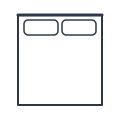
Queen Bed
A rectangle measuring 60 by 80 inches with a headboard strip. The most popular bed size in residential floor plans, suitable for most adult bedrooms.
Also: queen-size bed
Found in: Master bedrooms, guest rooms, secondary bedrooms
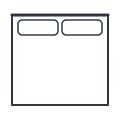
King Bed
A rectangle measuring 76 by 80 inches with a headboard strip. Requires significant room space. At least 12 by 12 feet for the bed plus nightstands and walkways.
Also: king-size bed, eastern king
Found in: Master bedrooms, large primary suites
Storage & Furniture

Nightstand
A small square (about 24 by 24 inches) drawn adjacent to the head of the bed, on one or both sides. Represents a small table for a lamp, phone, and personal items.
Also: bedside table, night table
Found in: Beside beds in all bedrooms

Dresser
A long, narrow rectangle (about 60 by 18 inches) along a wall, representing a multi-drawer clothing storage unit. Needs at least 36 inches in front for drawer clearance.
Also: chest of drawers, bureau
Found in: Bedroom walls opposite or adjacent to the bed

Closet
A recessed rectangular space with bifold or sliding door symbols at the opening and a horizontal line inside representing the rod and shelf. Standard depth is 24 inches.
Also: reach-in closet, bedroom closet, wardrobe closet
Found in: Every bedroom per building code, typically along one wall
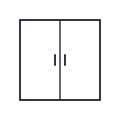
Wardrobe
A large rectangle (about 48 by 24 inches) against a wall, representing a freestanding furniture piece with doors for hanging clothes and drawers below.
Also: armoire, clothes wardrobe, freestanding closet
Found in: Bedrooms without built-in closets, older homes, apartments

Mirror
A thin rectangle drawn on the wall, sometimes with hatch marks or a label. Indicates a wall-mounted or full-length mirror, often placed near the closet or dresser.
Also: wall mirror, full-length mirror, dressing mirror
Found in: Near closets, above dressers, behind bedroom doors
Fixtures

Ceiling Fan
A circle with four lines extending outward like a plus sign, centered on the ceiling above the bed or room center. May include a light fixture symbol in the center.
Also: fan, overhead fan, fan with light
Found in: Centered in bedrooms, often above the bed, especially in warmer climates
How to Read Bedroom Floor Plan Symbols
Start with the bed. It is usually the largest symbol in the room and anchors the layout. Beds are drawn as rectangles with a headboard strip at one end and sometimes small ovals for pillows. The size matters enormously: a twin is 38 by 75 inches, a full is 54 by 75, a queen is 60 by 80, and a king is 76 by 80. On the plan, check that there is at least 24 inches of clearance on each side of the bed you need to access and 36 inches at the foot.
Closets are shown as recessed spaces with a door symbol (often bifold doors) and a single line across the interior representing the closet rod and shelf. Walk-in closets are larger spaces with their own doorway and may show shelving lines on multiple walls. The closet type tells you a lot about the bedroom. Master bedrooms typically have walk-in closets, while secondary bedrooms have standard reach-in closets.
Nightstands appear as small squares beside the bed, and dressers are long narrow rectangles along the walls. A wardrobe or armoire is a larger rectangle similar to a dresser but deeper. Look at the wall space available for these pieces. If the plan shows a dresser on a specific wall, that wall needs to be at least 5 feet long to accommodate it plus clearance.
Ceiling fans are drawn on the ceiling plan as a circle with lines extending in four directions, usually centered over the bed or in the middle of the room. A mirror may be shown as a thin rectangle on the wall, often near the dresser or closet area.
Common Mistakes
The biggest mistake is assuming a bedroom can fit a king bed just because the room is labeled a bedroom. Measure the plan carefully. A 10 by 10-foot room cannot practically fit a king bed with nightstands and dresser. People also confuse closet types: bifold doors indicate a standard closet, while a regular door to a small room indicates a walk-in. Finally, many buyers overlook bedroom window requirements. Building codes require egress windows in every bedroom for fire safety.
Pro Tips
- Measure the bed symbol against the room dimensions. A king bed needs a room at least 12 by 12 feet for comfortable clearance.
- Check that the closet door type makes sense for the space. Bifold doors need less clearance than swing doors.
- Every bedroom must have an egress window. Verify there is a window large enough to escape through in an emergency.
Frequently Asked Questions
How do you read bedroom symbols on a floor plan?
Start with the bed. It is usually the largest symbol in the room and anchors the layout. Beds are drawn as rectangles with a headboard strip at one end and sometimes small ovals for pillows. The size matters enormously: a twin is 38 by 75 inches, a full is 54 by 75, a queen is 60 by 80, and a king is 76 by 80. On the plan, check that there is at least 24 inches of clearance on each side of the bed you need to access and 36 inches at the foot.
What are common mistakes when reading bedroom symbols?
The biggest mistake is assuming a bedroom can fit a king bed just because the room is labeled a bedroom. Measure the plan carefully. A 10 by 10-foot room cannot practically fit a king bed with nightstands and dresser. People also confuse closet types: bifold doors indicate a standard closet, while a regular door to a small room indicates a walk-in. Finally, many buyers overlook bedroom window requirements. Building codes require egress windows in every bedroom for fire safety.
What does a twin bed look like on a floor plan?
A rectangle measuring 38 by 75 inches with a headboard strip at one short end. The smallest standard bed, suitable for children's rooms and compact spaces. Typically found in: children's bedrooms, guest rooms, dormitories, bunk setups.
What's the difference between a twin bed and a nightstand on a floor plan?
A twin bed is shown as a rectangle measuring 38 by 75 inches with a headboard strip at one short end, while a nightstand is shown as a small square (about 24 by 24 inches) drawn adjacent to the head of the bed, on one or both sides. The two are drawn differently so floor plan readers can distinguish them at a glance.
Which bedroom symbols are most commonly seen on residential floor plans?
The most common bedroom symbols you will see on a typical residential floor plan are: Twin Bed (a rectangle measuring 38 by 75 inches with a headboard strip at one short end); Full Bed (a rectangle measuring 54 by 75 inches with a headboard strip); Queen Bed (a rectangle measuring 60 by 80 inches with a headboard strip); King Bed (a rectangle measuring 76 by 80 inches with a headboard strip). The exact set depends on the home's layout and the architect's drawing conventions.
Download Bedroom Floor Plan Symbols Reference Sheet (PDF)
Print-friendly reference with all 10 symbols. Keep it on your desk or job site.
Related Symbol Categories
Furniture Floor Plan Symbols
15 symbols →
Lighting Floor Plan Symbols
10 symbols →
Electrical Floor Plan Symbols
22 symbols →
Ready to measure a floor plan?
PlanSnapper calculates square footage from any floor plan image. Free to start.