Home / Symbols / Architectural Floor Plan Symbols
Architectural Floor Plan Symbols
Architectural symbols represent the structural and circulation elements of a building. Stairs, columns, elevators, and other features that define how a building is built and how people move through it.
10 symbols across 2 subcategories
Measure any floor plan in minutes
Upload a floor plan, trace the perimeter, and get square footage instantly.
Structural Elements

Column
A small filled square or circle (typically 8 to 16 inches across) representing a vertical structural member that carries loads from the roof or upper floors down to the foundation.
Also: post, pillar, structural column
Found in: Open-plan areas, basements, parking garages, commercial spaces
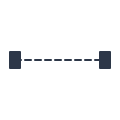
Beam
A dashed line drawn between two columns or wall supports, representing a horizontal structural member overhead. May be labeled with size (e.g., W12x26 for steel or 6x12 for wood).
Also: header, girder, structural beam
Found in: Above open spans, over removed walls, garage openings, large rooms

Pillar
Similar to a column but often drawn larger and circular, sometimes with decorative detail. May be partially embedded in a wall or freestanding as an architectural feature.
Also: pier, decorative column, support pillar
Found in: Entryways, porches, atriums, grand lobbies, exterior facades

Arch
A curved dashed line spanning a wall opening, indicating a curved header or passage. No door is present. The arch is an open decorative or structural element.
Also: archway, arched opening
Found in: Between living and dining rooms, hallway entries, Mediterranean and traditional style homes
Vertical Circulation
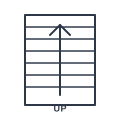
Stairs (Up)
A rectangle divided by parallel lines (representing treads) with an arrow pointing in the direction of ascent, labeled UP. A diagonal break line may indicate the stairs continue above the current view.
Also: staircase up, ascending stairs
Found in: Between floors, from first floor to second floor, basement to first floor
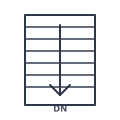
Stairs (Down)
Same as stairs up but with the arrow pointing in the descent direction, labeled DN or DOWN. Treads are drawn as parallel lines within a rectangular outline.
Also: staircase down, descending stairs
Found in: Access to basements, split-level transitions, sunken rooms

Spiral Stairs
A circle divided into pie-shaped wedges radiating from a center point, with each wedge representing a tread. An arrow curves around the perimeter showing the direction of travel.
Also: spiral staircase, circular stairs, helical stairs
Found in: Compact spaces, lofts, decorative feature stairs, exterior access
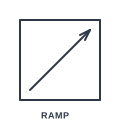
Ramp
A rectangle with an arrow showing the slope direction, often with the slope ratio noted (e.g., 1:12). Drawn wider than stairs and without tread lines.
Also: wheelchair ramp, incline, accessible ramp
Found in: Building entries, between split levels, parking garages, accessible routes

Elevator
A square or rectangle with an X drawn from corner to corner, representing the elevator shaft. Doors are indicated by a break in one wall of the shaft. May be labeled with capacity.
Also: lift, elevator shaft, passenger elevator
Found in: Multi-story buildings, commercial buildings, accessible residences
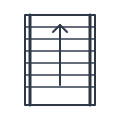
Escalator
Similar to stairs but drawn with a center arrow indicating continuous movement. May have tick marks representing the steps and is typically wider than a standard staircase.
Also: moving staircase, moving stairs
Found in: Shopping malls, airports, transit stations, department stores
How to Read Architectural Floor Plan Symbols
Architectural symbols depict the bones and circulation paths of a building. Columns are drawn as filled or hatched squares or circles and indicate where vertical structural supports pass through the floor. Beams are shown as dashed lines between columns, representing overhead structural members you cannot see from the floor but that affect ceiling height and where walls can be removed.
Stairs are among the most important architectural symbols to read correctly. They are drawn as a series of parallel lines (the treads) inside a rectangular outline. An arrow labeled UP or DN indicates the direction of travel as seen from the current floor. If the arrow says UP with an arrow pointing away, the stairs go up from this level. Spiral stairs are drawn as a circle divided into wedge-shaped treads radiating from a center pole.
Elevators appear as a square or rectangle with an X drawn corner-to-corner or with a pair of doors indicated at the shaft opening. The X represents the elevator shaft, and you may see dashed lines showing the cab interior. Escalators are drawn like stairs but with a distinctive arrow pattern showing the continuous movement direction.
Ramps are shown as sloped rectangles with an arrow indicating the direction of incline, often labeled with the slope ratio (like 1:12). They are critical for accessibility compliance. Arches are drawn as curved dashed lines spanning an opening, indicating there is no door but the wall has a curved header rather than a flat one.
Common Mistakes
The most common mistake with stair symbols is misreading the direction arrow. UP means the stairs ascend from the floor you are viewing, not that you are looking at the upper floor. Another error is ignoring column locations when planning furniture layouts or room configurations. Columns cannot be moved, and they may limit your options. People also frequently confuse structural beams (dashed lines overhead) with wall indications.
Pro Tips
- Stair arrows show direction from the floor level you are viewing. UP means climbing to the next floor from here.
- Filled or hatched columns are structural and cannot be removed. Plan furniture and rooms around them.
- Check ramp slopes for accessibility: ADA requires no steeper than 1:12 (one inch of rise per 12 inches of length).
Frequently Asked Questions
How do you read architectural symbols on a floor plan?
Architectural symbols depict the bones and circulation paths of a building. Columns are drawn as filled or hatched squares or circles and indicate where vertical structural supports pass through the floor. Beams are shown as dashed lines between columns, representing overhead structural members you cannot see from the floor but that affect ceiling height and where walls can be removed.
What are common mistakes when reading architectural symbols?
The most common mistake with stair symbols is misreading the direction arrow. UP means the stairs ascend from the floor you are viewing, not that you are looking at the upper floor. Another error is ignoring column locations when planning furniture layouts or room configurations. Columns cannot be moved, and they may limit your options. People also frequently confuse structural beams (dashed lines overhead) with wall indications.
What does a column look like on a floor plan?
A small filled square or circle (typically 8 to 16 inches across) representing a vertical structural member that carries loads from the roof or upper floors down to the foundation. Typically found in: open-plan areas, basements, parking garages, commercial spaces.
What's the difference between a column and a stairs (up) on a floor plan?
A column is shown as a small filled square or circle (typically 8 to 16 inches across) representing a vertical structural member that carries loads from the roof or upper floors down to the foundation, while a stairs (up) is shown as a rectangle divided by parallel lines (representing treads) with an arrow pointing in the direction of ascent, labeled UP. The two are drawn differently so floor plan readers can distinguish them at a glance.
Which architectural symbols are most commonly seen on residential floor plans?
The most common architectural symbols you will see on a typical residential floor plan are: Column (a small filled square or circle (typically 8 to 16 inches across) representing a vertical structural member that carries loads from the roof or upper floors down to the foundation); Beam (a dashed line drawn between two columns or wall supports, representing a horizontal structural member overhead); Pillar (similar to a column but often drawn larger and circular, sometimes with decorative detail); Arch (a curved dashed line spanning a wall opening, indicating a curved header or passage). The exact set depends on the home's layout and the architect's drawing conventions.
Download Architectural Floor Plan Symbols Reference Sheet (PDF)
Print-friendly reference with all 10 symbols. Keep it on your desk or job site.
Related Symbol Categories
Wall Floor Plan Symbols
9 symbols →
Door Floor Plan Symbols
10 symbols →
Window Floor Plan Symbols
10 symbols →
Ready to measure a floor plan?
PlanSnapper calculates square footage from any floor plan image. Free to start.