Home / Symbols / Wall Floor Plan Symbols
Wall Floor Plan Symbols
Wall symbols are the most fundamental elements on a floor plan. They define every room, corridor, and space in a building. Different line weights, patterns, and fills distinguish structural walls from partitions, exterior from interior, and fire-rated from standard walls.
9 symbols across 2 subcategories
Measure any floor plan in minutes
Upload a floor plan, trace the perimeter, and get square footage instantly.
Structural Walls

Exterior Wall
The thickest parallel lines on the plan (typically 6 to 12 inches), often with insulation hatching or a fill pattern between them. Defines the building envelope and boundary.
Also: outer wall, perimeter wall, building envelope wall
Found in: The entire building perimeter, defining the boundary between interior and exterior
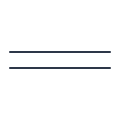
Interior Wall
Parallel lines thinner than exterior walls (typically 4 to 6 inches), dividing interior spaces. May be load-bearing or non-load-bearing depending on structural design.
Also: dividing wall, room wall, inside wall
Found in: Between all interior rooms, defining bedrooms, bathrooms, closets, and corridors

Load-Bearing Wall
Drawn with a solid fill, heavy hatching, or a specific label (LB), indicating this wall carries structural loads from above. Must not be removed without engineering approval.
Also: structural wall, bearing wall, support wall
Found in: Parallel to roof ridge, above foundation walls or beams, center of building span

Firewall
A wall drawn with a distinctive solid fill and labeled with a fire rating (1-HR, 2-HR), indicating it can resist fire for the specified duration. Extends from floor to roof deck.
Also: fire-rated wall, fire separation, fire barrier
Found in: Between garage and living space, between townhouse units, around stairwells and elevators
Partition & Specialty Walls

Partition Wall
Thin parallel lines (typically 3.5 to 4 inches) with a hollow or light fill, indicating a non-structural wall used only to divide space. Can be easily added or removed.
Also: non-bearing wall, divider wall, stud wall
Found in: Office layouts, room subdivisions, closet walls, bathroom enclosures

Curtain Wall
A thin line or double line with glass infill indication, representing a non-structural exterior cladding system, typically aluminum-framed glass panels that hang from the structure.
Also: glass curtain wall, glazed wall, window wall
Found in: Modern commercial buildings, high-rise facades, atriums, storefronts
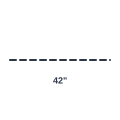
Half Wall
A wall drawn with a dashed line or thinner weight, or labeled with its height (e.g., 42 inches), indicating a wall that does not extend to the ceiling. Often used as a visual divider.
Also: knee wall, pony wall, partial wall
Found in: Between kitchen and living areas, staircase guards, bathroom privacy walls, loft railings
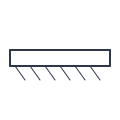
Retaining Wall
A thick wall symbol with hatching on one side indicating the earth or higher grade it holds back. Usually thicker at the base than at the top. Shown on site plans and foundation plans.
Also: retainer wall, earth retention wall, grade wall
Found in: Hillside foundations, terraced landscapes, basement walls against grade, garage sub-grade walls

Glass Wall
A thin single or double line with a specific glass symbol. Small diamonds, dots, or the label GL. Indicating a full-height glass partition. May include a door symbol for glass door entries.
Also: glass partition, glazed partition, glass divider
Found in: Office conference rooms, shower enclosures, modern residential interiors, storefronts
How to Read Wall Floor Plan Symbols
Walls are drawn as parallel lines with the space between them representing the wall thickness. The most important distinction is line weight: exterior walls are drawn with the thickest lines (typically 6 to 12 inches thick on the plan), while interior walls use thinner lines (usually 4 to 6 inches). This thickness difference reflects real construction. Exterior walls contain insulation, sheathing, and weather barriers, making them physically thicker.
The fill between the parallel lines tells you about the wall construction. A solid black fill or heavy hatching usually indicates a load-bearing wall. One that carries the weight of the structure above. These walls cannot be removed during renovation without adding alternative structural support. A hollow or lightly filled wall is typically a non-load-bearing partition that can be removed or relocated more easily.
Specialty walls have their own visual language. Glass walls or curtain walls are drawn as thin single or double lines, sometimes with a specific glass pattern or the letter G. Fire-rated walls (firewalls) are shown with a distinctive pattern. Often a solid fill with specific rating labels like 1-HR or 2-HR, indicating how long the wall can withstand fire. Half walls or knee walls are drawn with a dashed line or thinner weight to show they do not reach the ceiling.
When reading a floor plan, start with the exterior walls to understand the building footprint. Then identify interior load-bearing walls (usually running parallel to the ridge of the roof or directly above a beam in the floor below). Finally, look at partition walls to understand room layouts. Understanding which walls are structural is essential before planning any renovation.
Common Mistakes
The biggest mistake is assuming all walls can be moved. Load-bearing walls are structural and removing them requires engineering analysis and often a replacement beam. Another error is ignoring wall thickness when measuring rooms. The clear interior dimension is less than the distance between wall centerlines. People also frequently overlook fire-rated wall designations, which are critical in multi-family buildings and between garages and living spaces.
Pro Tips
- Thicker wall lines usually mean exterior or load-bearing walls. Do not plan to remove these without an engineer.
- Measure room sizes from the inside face of the walls, not the centerlines. Wall thickness matters.
- Look for fire rating labels on walls between the garage and living space. These are code-required safety barriers.
Frequently Asked Questions
How do you read wall symbols on a floor plan?
Walls are drawn as parallel lines with the space between them representing the wall thickness. The most important distinction is line weight: exterior walls are drawn with the thickest lines (typically 6 to 12 inches thick on the plan), while interior walls use thinner lines (usually 4 to 6 inches). This thickness difference reflects real construction. Exterior walls contain insulation, sheathing, and weather barriers, making them physically thicker.
What are common mistakes when reading wall symbols?
The biggest mistake is assuming all walls can be moved. Load-bearing walls are structural and removing them requires engineering analysis and often a replacement beam. Another error is ignoring wall thickness when measuring rooms. The clear interior dimension is less than the distance between wall centerlines. People also frequently overlook fire-rated wall designations, which are critical in multi-family buildings and between garages and living spaces.
What does an exterior wall look like on a floor plan?
The thickest parallel lines on the plan (typically 6 to 12 inches), often with insulation hatching or a fill pattern between them. Defines the building envelope and boundary. Typically found in: the entire building perimeter, defining the boundary between interior and exterior.
What's the difference between an exterior wall and a partition wall on a floor plan?
An exterior wall is shown as the thickest parallel lines on the plan (typically 6 to 12 inches), often with insulation hatching or a fill pattern between them, while a partition wall is shown as thin parallel lines (typically 3.5 to 4 inches) with a hollow or light fill, indicating a non-structural wall used only to divide space. The two are drawn differently so floor plan readers can distinguish them at a glance.
Which wall symbols are most commonly seen on residential floor plans?
The most common wall symbols you will see on a typical residential floor plan are: Exterior Wall (the thickest parallel lines on the plan (typically 6 to 12 inches), often with insulation hatching or a fill pattern between them); Interior Wall (parallel lines thinner than exterior walls (typically 4 to 6 inches), dividing interior spaces); Load-Bearing Wall (drawn with a solid fill, heavy hatching, or a specific label (lb), indicating this wall carries structural loads from above); Firewall (a wall drawn with a distinctive solid fill and labeled with a fire rating (1-hr, 2-hr), indicating it can resist fire for the specified duration). The exact set depends on the home's layout and the architect's drawing conventions.
Download Wall Floor Plan Symbols Reference Sheet (PDF)
Print-friendly reference with all 9 symbols. Keep it on your desk or job site.
Related Symbol Categories
Door Floor Plan Symbols
10 symbols →
Window Floor Plan Symbols
10 symbols →
Architectural Floor Plan Symbols
10 symbols →
Ready to measure a floor plan?
PlanSnapper calculates square footage from any floor plan image. Free to start.