Home / Symbols / Window Floor Plan Symbols
Window Floor Plan Symbols
Window symbols on floor plans indicate the type, size, and operation of every window in a building. Reading these symbols correctly helps you understand natural light, ventilation, and emergency egress.
10 symbols across 2 subcategories
Measure any floor plan in minutes
Upload a floor plan, trace the perimeter, and get square footage instantly.
Standard Windows
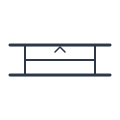
Single Hung Window
A single line within the wall opening representing the glass, with a slight indication that only the bottom sash moves. The top sash is fixed in place.
Also: single-hung sash, bottom-opening window
Found in: Bedrooms, living rooms, most residential applications

Double Hung Window
Similar to single-hung but with a slight offset or double line in the center indicating both sashes are operable. Both the top and bottom panels can slide open.
Also: double-hung sash, traditional sash window
Found in: Living rooms, bedrooms, dining rooms, historic or traditional homes
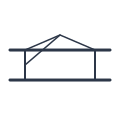
Casement Window
A line within the wall opening with a small arc showing the swing direction, similar to a door symbol but contained within the wall thickness. Hinged on one side, cranks open outward.
Also: crank window, swing-out window
Found in: Kitchens above sinks, bathrooms, hard-to-reach locations, modern homes
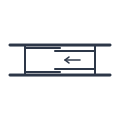
Sliding Window
Two overlapping lines within the wall opening, showing one fixed panel and one that slides horizontally past it. Similar concept to a sliding door but smaller.
Also: gliding window, slider window, horizontal slider
Found in: Basements, bathrooms, contemporary homes, above kitchen counters
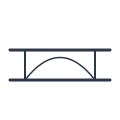
Awning Window
A line within the wall opening with a small arc indicating the window hinges at the top and swings outward from the bottom. Allows ventilation even during light rain.
Also: top-hinged window, hopper window (when opening inward)
Found in: Bathrooms, basements, above or below fixed windows, clerestory applications
Fixed / Picture Window
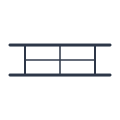
Three parallel lines within the wall opening. The two outer lines are the wall faces and the center line is the glass. No arc or movement indicator because this window does not open.
Also: picture window, non-operable window, fixed pane
Found in: Living rooms with views, above doors, transom positions, stairwells
Specialty Windows

Bay Window
A trapezoidal bump-out from the exterior wall line, typically with a wide center window and two angled side windows. The wall line jogs outward to show the projection.
Also: bay, projecting window, garden window
Found in: Living rooms, dining rooms, master bedrooms, breakfast nooks
Bow Window
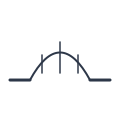
A curved bump-out from the exterior wall line, formed by four or more window panels arranged in a gentle arc. Creates a wider, more gradual projection than a bay window.
Also: bow, curved bay window
Found in: Living rooms, formal dining rooms, front-facing rooms

Skylight
A rectangle with an X drawn corner-to-corner, shown on the roof plan. On floor plans, it may appear as a dashed rectangle on the ceiling representing light from above.
Also: roof window, roof light, overhead window
Found in: Bathrooms, kitchens, hallways, stairwells, attic spaces
Clerestory Window
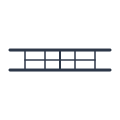
A row of small window symbols placed high on an interior or exterior wall near the ceiling line, allowing light in while maintaining wall space below for furniture or storage.
Also: high window, clearstory, ribbon window
Found in: Above rooflines of adjacent spaces, great rooms, churches, modern homes
How to Read Window Floor Plan Symbols
Window symbols are drawn as breaks in the wall lines, with internal details showing the window type. The simplest window symbol is three parallel lines spanning the wall opening. The outer two are the wall surfaces and the center line represents the glass. This basic form represents a fixed (non-opening) window.
For operable windows, the symbol changes to show how the window opens. A single-hung or double-hung window shows a single line in the wall opening to represent the glass, sometimes with a slight offset to show the overlapping sashes. A casement window. Which swings open like a door. Is drawn with an arc similar to a door symbol, showing the swing direction. Sliding windows show two overlapping lines, similar to a sliding door.
Bay and bow windows project outward from the wall line. A bay window appears as a trapezoidal bump-out with angled side windows, while a bow window shows a curved bump-out. These are easy to spot because they change the wall footprint. Skylights are drawn on the roof plan (not the floor plan) as rectangles with an X, and may be noted on the floor plan with a dashed rectangle on the ceiling.
Always check window schedules on the plan. A table that lists each window by number with its exact dimensions, type, and specifications. The schedule gives you more detail than the symbol alone, including U-values, glass type, and manufacturer specifications.
Common Mistakes
People commonly confuse casement windows with doors because both use an arc symbol. Casement arcs are smaller and drawn within the wall thickness, while door arcs extend into the room. Another mistake is assuming all window symbols are the same scale. Always check labeled dimensions. Many people also overlook the difference between fixed and operable windows; fixed windows provide light but no ventilation.
Pro Tips
- Casement windows have a small arc like a door. The arc shows which direction the window swings open.
- Check egress requirements: bedrooms typically need at least one window large enough to climb through in an emergency.
- Look at the window schedule for exact sizes. The plan symbol shows type and location, but the schedule has dimensions.
Frequently Asked Questions
How do you read window symbols on a floor plan?
Window symbols are drawn as breaks in the wall lines, with internal details showing the window type. The simplest window symbol is three parallel lines spanning the wall opening. The outer two are the wall surfaces and the center line represents the glass. This basic form represents a fixed (non-opening) window.
What are common mistakes when reading window symbols?
People commonly confuse casement windows with doors because both use an arc symbol. Casement arcs are smaller and drawn within the wall thickness, while door arcs extend into the room. Another mistake is assuming all window symbols are the same scale. Always check labeled dimensions. Many people also overlook the difference between fixed and operable windows; fixed windows provide light but no ventilation.
What does a single hung window look like on a floor plan?
A single line within the wall opening representing the glass, with a slight indication that only the bottom sash moves. The top sash is fixed in place. Typically found in: bedrooms, living rooms, most residential applications.
What's the difference between a single hung window and a bay window on a floor plan?
A single hung window is shown as a single line within the wall opening representing the glass, with a slight indication that only the bottom sash moves, while a bay window is shown as a trapezoidal bump-out from the exterior wall line, typically with a wide center window and two angled side windows. The two are drawn differently so floor plan readers can distinguish them at a glance.
Which window symbols are most commonly seen on residential floor plans?
The most common window symbols you will see on a typical residential floor plan are: Single Hung Window (a single line within the wall opening representing the glass, with a slight indication that only the bottom sash moves); Double Hung Window (similar to single-hung but with a slight offset or double line in the center indicating both sashes are operable: both the top and bottom panels can slide open); Casement Window (a line within the wall opening with a small arc showing the swing direction, similar to a door symbol but contained within the wall thickness); Sliding Window (two overlapping lines within the wall opening, showing one fixed panel and one that slides horizontally past it). The exact set depends on the home's layout and the architect's drawing conventions.
Download Window Floor Plan Symbols Reference Sheet (PDF)
Print-friendly reference with all 10 symbols. Keep it on your desk or job site.
Related Symbol Categories
Wall Floor Plan Symbols
9 symbols →
Door Floor Plan Symbols
10 symbols →
Architectural Floor Plan Symbols
10 symbols →
Ready to measure a floor plan?
PlanSnapper calculates square footage from any floor plan image. Free to start.